


A Wind Energy Industry Engineer Reflects on Equipping Eagles With Flight Trackers, Preparing
Higher education Students for Professions in Clean Vitality, and Using His Information To Make a Optimistic
Impression

as a wind energy subject take a look at engineer at NREL. Impression by John Frenzl, NREL
Wind turbines loomed big in Jason Roadman’s consciousness before he at any time carried a National Renewable Power Laboratory (NREL)
employee badge.
In the late 2000s, Roadman lived in Golden, Colorado, and was performing on a master
of science diploma in aerospace engineering at the University of Colorado Boulder.
His day-to-day commute took him alongside Colorado Condition Highway 93, a windblown street that
traverses the japanese foundation of the Rocky Mountains and passes by NREL’s Flatirons Campus—home
to the Countrywide Wind Technology Center.
“I noticed the campus’s initially utility-scale wind turbines go up, and I considered, ‘Those
glimpse actually cool,’” Roadman recalled.
But it was not just the novelty of the wind turbines that fascinated Roadman. It was
the thought of working with his aerospace schooling to make a beneficial influence.
“One career path available to me with my aerospace diploma was weapons design and style and producing,”
Roadman defined. “But I desired to use my understanding to support instead than hurt. I knew
wind turbines generate electric power with out polluting the air, which allows the atmosphere.
And I figured there was some aerospace engineering included in wind turbines.”
Motivated by this different route, Roadman begun exploring his networks. Pat Moriarty,
an NREL engineer who Roadman knew as a result of his master’s diploma committee, encouraged
Roadman to apply for an engineering contractor placement at NREL. Roadman received the contractor
task in 2011 and turned a entire-time NREL researcher in 2014.
Right now, Roadman is an utilized analysis engineer at the National Wind Technological innovation Center,
the place he coordinates and conducts subject experiments on the campus’s exploration wind
turbines and is the selected spot agent for the U.S. Division of Energy’s
(DOE’s) 1.5-megawatt (MW) turbine. Roadman also serves on the staff that organizes
the DOE Collegiate Wind Levels of competition (CWC), an yearly competitors that aids college pupils get ready for work opportunities in wind
and renewable electrical power.
For the next dialogue, we caught up with Roadman as he was setting up an
experiment on the DOE 1.5-MW turbine to evaluate acoustic emissions.
To get started off, in layman’s conditions, what do you do at the Countrywide Wind Engineering
Middle?
As an used research engineer, I just take a wide variety of sensors and set them on wind
turbines to measure how the turbines do diverse matters. For instance, these days, I’m
measuring the degree of noise the DOE 1.5-MW turbine generates although its blades are
spinning. For other experiments, I may evaluate how significantly power turbines crank out
offered the environmental ailments. How do the turbines react to temperature, air
tension, humidity, or other environmental modifications? How substantially load, or anxiety, are
the turbine’s blades and the rest of the turbine composition experiencing? I offer
these knowledge to other researchers or sector partners for assessment.
Then, as an organizer for the CWC, I guide the enhancement of our annual policies doc
and keep and update our wind tunnels, which teams use to exam their design wind
turbines at our ultimate party. All through the competition’s remaining function every spring, I act
as head rules judge, indicating I ensure all pupil teams comply with the procedures, and
I get the job done with the CWC organizers to tackle queries about the rules. I also act as
the turbine screening choose, that means I examine the turbines for compliance and operate the
wind tunnel when the college students are tests.
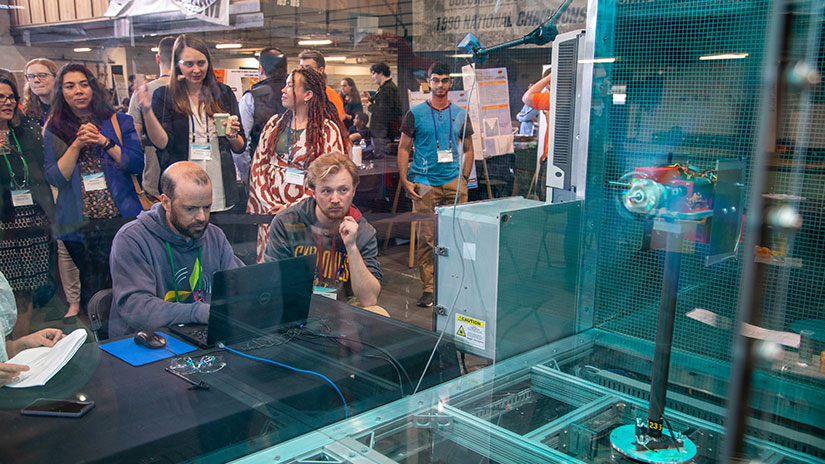
assesses how students’ model wind turbines accomplish in the competition’s turbine screening
tunnel. Photograph by Taylor Mankle, NREL
What challenges do you address, or what wants do you meet, by managing subject tests on wind
turbines and aiding arrange the CWC?
Concerning my industry experiment function, I assistance push the analysis that prepares wind turbines
for the professional sector. The Flatirons Campus was designed in a distinctive wind environment.
Simply because of our site on the eastern base of the Rocky Mountains and at the mouth
of Eldorado Canyon, we get incredibly variable wind ailments and wind speeds larger
than what most wind farms see every year. That signifies we’re able to characterize, or
report, the sorts of powerful circumstances that a wind turbine may possibly knowledge. A ton
of our do the job will involve utilizing the many analysis turbines on campus to forecast how
nicely more recent turbines can stand up to intensive wind circumstances. Also, mainly because the wind
circumstances at our location modify so frequently, we can check new systems more
speedily than we could at a area with considerably less variable disorders.
When it will come to my function on the Collegiate Wind Competition, both land-based and offshore wind energy are poised for major progress more than the
future couple a long time, which suggests people industries are going to want a massive inflow of employees to fill
all forms of roles—not just engineers, but finance people, environmental analysts,
and public relations specialists. The CWC allows teach that upcoming technology of staff,
equipping them with the techniques, knowledge, and qualified connections that will
enable them crack into the marketplace.
What are you working on appropriate now that you’re especially enthusiastic about?
We just wrapped up the 2024 Collegiate Wind Levels of competition, and we’re still accepting programs for CWC 2025! We held CWC 2024 May perhaps 6–9 at the American Clean Electric power Association’s CLEANPOWER meeting
in Minneapolis. The level of competition is always a terrific fruits of the operate the pupils
have done around the past faculty 12 months, and it is a good networking prospect. College students
get to satisfy every other and share thoughts, and, simply because the remaining celebration takes area at
a convention for users of the renewable electricity business, they sometimes even meet up with
their long term businesses. It’s extremely rewarding to know that the CWC is encouraging college
graduates locate employment and supporting the wind and renewable strength industries find staff.
I can tell the CWC really fills your sails, so to talk! What other projects have
you been equally jazzed about?
Back in 2016, we did an experiment accumulating chook flight data to aid organizations that have been establishing technologies decrease chicken collisions with wind
turbines. We had a team of scientists who were building devices that would detect
birds and bats around wind turbines, with the thought that the turbines would end spinning
in advance of the animals acquired near. The researchers wanted to examination how perfectly the technological innovation
could detect real flying objects, but at the time, Federal Aviation Administration
polices made it tricky to fly unmanned plane.
I acquired the strategy to place a GPS tracker on an true chicken and fly it all over the turbines
at the Flatirons Campus. My sister, a wildlife biologist, inspired the plan. I went
down to the neighborhood hawking club and, astonishingly, a number of members were incredibly interested
in the study. By means of people people, I related with Auburn College, who agreed
to convey their skilled eagles, Spirit and Nova, out to the Flatirons Campus for the
industry take a look at. We tested two diverse technologies—one radar-dependent and a person digicam-dependent.
Some wind farms now use the digicam-centered know-how to detect golden eagles and shut
the turbines down if the eagles are current. Major that experiment, looking at these
eagles fly all-around the campus, and knowing we were being accumulating info that would aid
preserve other eagles secure about wind turbines was one particular of the coolest matters I’ve ever
accomplished in my occupation.

In an NREL vocation highlight, Roadman labored with educated eagles to gather information on
chicken flight patterns. The details supported know-how improvement to minimize hen collisions
with wind turbines. Photograph by Dennis Schroeder, NREL
That seems like an astounding working experience! What tips do you have for individuals who’d like
to do what you do?
I have quite a few parts of guidance. First, participate in an engineering and style opposition,
irrespective of whether that’s CWC or a little something else. I’ve participated in engineering and layout
competitions in different capacities for 28 many years now—first as a university student competitor
in junior higher, substantial faculty, and faculty, and afterwards as an advisor, a decide, and an
organizer. The explanation I have stayed associated with these styles of competitions is they
give you the possibility to implement anything you master in your engineering lessons to real-world
challenges.
Next, do not just community. Devote time shadowing persons who are performing get the job done that passions
you. Which is why the CWC and equivalent courses are so useful: They join pupils
with folks in wind and renewable electrical power, which gives pupils a probability to master firsthand
about the positions they’re learning to do. When I was in graduate faculty and checking out
vocation paths, I would go to operate with pals who labored at companies I was fascinated
in. I’d satisfy their colleagues and bosses, request concerns about their work, learn what
was heading on at their corporations. That tactic gave me the self-assurance to know NREL
was the right match when the opportunity came up. When I began doing the job at NREL, mainly because
I’d previously performed a ton of palms-on profession exploration, I knew I’d landed in the proper
position. 13 years later on, I’m however exactly where I want to be.
Lastly, if you’re a faculty university student or professor looking at this, apply for CWC 2025! We’re accepting applications until finally 4:59 p.m. MT on June 13, 2024.
Find out a lot more about NREL’s wind energy exploration, offshore wind electricity in specific, and the incredible folks at the rear of the blades by subscribing to the Foremost Edge newsletter.