


The human ingredient is the weakest website link in protection. Attackers target end users through a wide range of social engineering and phishing methods. To reinforce protection for person accounts and avert account takeover, multifactor authentication is key.
MFA enhances safety by incorporating other aspects along with passwords that buyers will need to know, present or be when logging in. MFA factors contain one particular-time passwords despatched by text, electronic mail or an authenticator app tokens biometrics and behavioral evaluation. By incorporating additional than 1 variable to authentication, organizations lessen the possible damage caused by compromised passwords and accounts.
For these having started out, below are many tips for applying MFA, from vendors and implementations to how to examine rolling out MFA with consumer guidance. These strategies arrive from Marco Fanti, creator of Employing Multifactor Authentication and director of devices engineering at BehavioSec.
1. Decide on a vendor
The 1st step for any corporation is to pick out a seller for its MFA deployment. Organizations are spoiled for preference with substantial enterprise distributors and specialised types.
In Implementing Multifactor Authentication, Fanti advisable Microsoft Entra ID (formerly Azure Lively Directory) as a potent choice to defend employee, contractor and husband or wife accounts, in particular if the group currently employs Microsoft products and solutions. Entra ID supplies identity and entry administration (IAM) capabilities, these kinds of as MFA, single indication-on (SSO), conditional obtain and continual authentication. To fortify protection more, companies could also adopt Cisco Duo as a secondary authentication factor.
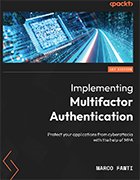 Click on to study far more about
Employing Multifactor
Authentication.
Another option is IAM seller Okta, which presents cloud-primarily based employee and consumer MFA products and solutions with Okta Workforce Identity and Okta Customer Identification, respectively. Okta offers phishing-resistant authentication, governance, lifecycle management and extra. Organizations can include Okta to their custom applications to deal with MFA and other authentication capabilities.
Other IAM distributors Fanti pointed to incorporate ForgeRock, Ping Identification and 1Kosmos.
Fanti highlighted these suppliers exclusively due to the fact they give totally free trials for stakeholders to try each and every with exam teams and make your mind up which is effective ideal.
If organizations like an open up resource IAM item, contemplate Keycloak. The IAM tool features several of the identical characteristics that seller products and solutions do, these types of as MFA, SSO and federation. “I uncovered that Keycloak delivers the most assist for all the distinct functions an organization and I would want out of an IAM merchandise,” Fanti claimed.
2. Decide on MFA strategies
The moment businesses have chosen an MFA seller, they should identify MFA solutions for personnel, associates, prospects and some others.
MFA methods include the next:
- Time-based one particular-time codes, often sent by way of text or email.
- Authenticator purposes on a user product.
- Hardware protection keys.
- Biometrics, which can include things like facial or fingerprint recognition.
- Adaptive authentication, these kinds of as authenticating users by way of location or machine use.
Companies must weigh the execs and negatives of MFA solutions centered on how they have an impact on protection compared to UX. For instance, SMS is straightforward for people, but it is not the most safe solution obtainable.
“SMS was a favorite system at a single position simply because it was straightforward to employ. But it has a ton of problems that attackers can take benefit of,” Fanti stated. “For instance, they applied to be able to connect with their company and say, ‘I misplaced my cell phone you should change my quantity to this new SIM’ and consider over your amount and trick SMS MFA.”
Fanti suggested passkeys, which have come to be a scorching topic in stability. “I have superior hopes for passkeys,” he stated, but he pointed out the technique has a finding out curve. “Even with passkeys, if you share it with anyone, it could result in the consumer troubles dependent on the type of passkey utilized. It is really not uncomplicated for a person to realize that or what a passkey is when compared to a password because they audio identical.”
3. Entail staff early and demonstrate MFA positive aspects
The moment an organization selects MFA approaches, it’s time to talk about these safety updates with people impacted, including staff and shoppers. When MFA just isn’t new, workers and consumers might not understand what just it is, how it affects them and how they ought to deal with it.
Fanti suggested companies employ the service of a complex writer who understands IAM and MFA processes and technological know-how and can make clear the relevance of MFA to personnel and stakeholders. Personnel may not be specialized adequate to comprehend MFA at 1st, and this could help them.
A very good communicator can clarify what the corporation is accomplishing, why and how. They can also deal with how points will improve and increase or how things could get even worse prior to they get far better, Fanti claimed.
Consumer pushback is pure, but buyers need to understand the rewards of MFA. For example, Fanti worked with fiscal businesses the place some traders pushed back again in opposition to MFA simply because it slowed down their means to make or complete trades.
“But, on the other facet, they’re accomplishing multimillion-dollar trades, and you need to have safety to make sure it really is the real trader,” he pointed out. Using a method these kinds of as continual MFA can support counter this. It identifies users’ usual browser and spot and determines if an individual has logged into a user’s browser to impersonate them.
4. Get ready for user friction
MFA can help corporations enhance their security and retain person accounts out of destructive hands, but it can also generate friction and hinder UX by slowing down how quickly users can log in to accounts. Using additional steps, these as checking an application or email for a code, can frustrate them.
Corporations must count on some original pushback and grievances as people begin utilizing MFA. These issues lessen as consumers change.
A person alternative is to undertake MFA methods that never have to have considerably effort and hard work from buyers. For instance, biometrics are secure, and users are acquainted with them in their each day life, presented quite a few mobile units have facial recognition capabilities. Plus, this approach also doesn’t incorporate much time to the login method.
Behavioral and constant authentication also can operate in an organization’s favor. Both equally fortify account stability devoid of changing how users interact with a product. BehaviorSec employs behavioral biometrics internally and with its buyers.
“In most situations, if we can warranty — or virtually guarantee — the person is who they claim to be, we could not involve them to use traditional MFA when we really don’t require to,” Fanti mentioned. For instance, IAM displays the place buyers generally log in to their accounts and notes if a login endeavor occurs from somewhere diverse. “There may possibly be friction at to start with, but buyers will adapt,” he explained. Additionally, suppliers make processes and items a lot less intrusive to UX as they advance.
5. Put together for id-centered assaults
MFA is a impressive tool versus password breaches and account takeover assaults. But malicious attackers have figured out how to bypass some sorts of MFA as a result of social engineering.
To address this, organizations should prepare workforce about the kinds of social engineering. “Stopping social engineering attacks is mainly just producing positive people are educated to detect and be wary about suspicious e-mails, links and extra,” Fanti stated.
Businesses can also decide to only allow a lot more protected MFA use and lessen some of the tension put on staff to be great.
“A organization could use authenticators for MFA, such as Microsoft Authenticator. They set the site where by an individual is making an attempt to log in from or call for users to sort in a random range of digits to affirm they are the suitable user,” Fanti stated.
An additional selection is to use continuous or behavioral authentication resources. “These monitor regardless of whether a consumer out of the blue does a thing they typically would not or check out to log in from an abnormal area,” he stated.
“Nevertheless, education and learning is what I’d suggest most,” Fanti reported. “Test to stop productive MFA bypass attacks from going on and then try out to mitigate them when they do happen.”
Kyle Johnson is technology editor for TechTarget Security.